
CRI and Colour Temperature for Bathroom Lighting (Part Four)
30 Sep 2026
If you've followed Part One, Part Two and Part Three, you know what you want to see in your bathroom and how you want to see it. Now it's time to choose your light fittings. There's plenty to check on a spec sheet (How to Compare Light Fittings covers it), but in the bathroom, colour rendering and colour temperature matter most.
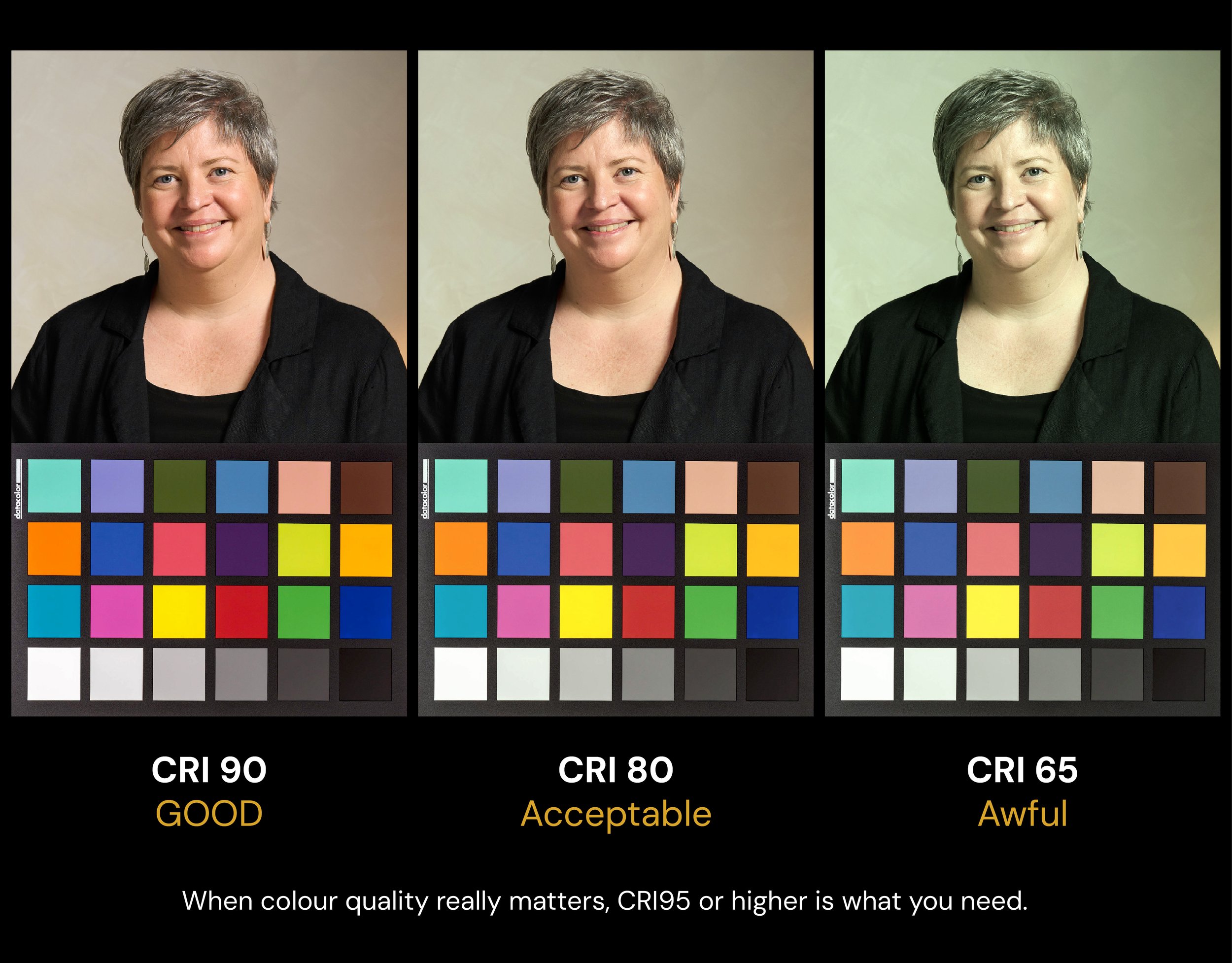
Your skin is the most colour-critical surface in the house
In the bathroom, your light has to show skin tones accurately. If it doesn't, your reflection looks "off colour" in the mirror, which is not a great way to start the day.
Light quality is measured by the Colour Rendering Index, or CRI. It describes how accurately a light source shows colours, on a scale up to 100, and the lower the number, the poorer the colour. The CRI on a spec sheet is an average of the fitting's test results, and it's different for every light fitting.
Sunlight has the best colour rendering of all, and if you can get daylight into your bathroom, you're on a winner. It isn't always available, which is where carefully selected light fittings come in.
You'll see plenty of fittings at CRI80. At the mirror, CRI 90+ is non-negotiable, and if makeup is critical, look for CRI95 or higher. Quality manufacturers mark the CRI (sometimes shown as Ra) clearly on their spec sheets, and if you can't find it, that tells you something too.
Choose your colour temperature, then stick with it
Colour temperature, measured in kelvin (K), describes how warm or cool the light looks. There's a fair bit of complexity to it in LED light sources, but what matters most is how you want your bathroom to feel.
Cooler light (4000K neutral white) in a white bathroom can feel surgical to some, while to others it feels clean, bright and airy. At MINT, we believe the best choice is a good quality 3000K warm white. It's white with a little hint of warmth, which gives you light and bright along with a calm and kind light. Personally, that's what I want in the mirror (particularly first thing), a calm and kind reflection.
For a powder room with a deluxe feel, the decorative lighting can go warmer, to 2700K, making the room feel moody, luxurious and relaxing.
There's no single right answer, but there is one wrong one: mixing warm and cool light in the same room (or the same house, for that matter). Check anything with built-in light, like lit mirrors and cabinets, because they're often cool white. For more, read The Difference Between Warm and Cool Light.

Lighting one bathroom?
Our Bathroom Lighting Design Made Easy guide includes seven checks to do before you buy, from lumens and beam angles to CRI, colour temperature and dimming. Use code READBATHBLOGS for 10% off. Get the guide →
Building or renovating the whole house?
MINT designs lighting for whole homes across Australia and internationally, with one consistent colour of light from the front door to the ensuite. We don't sell light fittings, which leaves us free to recommend whatever suits your home, from any brand. Explore our home lighting design services →
Colour is the part of lighting you feel before you notice it. Get it wrong and the bathroom never quite feels right, even if you can't say why. Get it right, and the room simply feels good to be in, first thing in the morning and last thing at night.